WE SHIP WORLDWIDE | TOLL FREE (800) 438-3226
WE SHIP WORLDWIDE | TOLL FREE (800) 438-3226
Purchase a used 20×20-foot (approximately 6 x 6-meter) tent between October and February. Business for tent rental companies slows down during the winter; this is when they review their inventory, assess the condition of each piece of equipment, and decide which of their older tents to put up for sale.
In fact, InTents magazine, a publication specializing in the tent industry, advises rental companies to conduct this type of review during the off-season, including selling off equipment that no longer justifies the space it occupies in their warehouses.
Since there are fewer buyers during the colder months, sellers are more open to negotiation. You also have the time needed to set up the tent, inspect it, and order any replacement parts before your next outdoor event.
Keep in mind, however, that local demand can cause this time frame to vary. In regions with warmer climates, where outdoor events take place year-round, the off-season is shorter. Therefore, keep an eye on listings while taking the weather conditions in your specific area into account.
Season | Buying conditions | Verdict |
|---|---|---|
October to February | Rental companies clear older inventory, demand is low, and you have time to inspect and repair. | Best time |
March to May | Event season starts, buyers compete for the same tents, and sellers hold firm on price. | Worst time |
June to September | Most event tents are out on rentals. Fewer listings, and a tent sold mid-season may come straight off heavy use. | Possible, check condition closely |
The displayed price never reflects the true total cost. A used tent comes with an unknown history, and it is precisely in the gap between the initial purchase price and the final expenses that most buyers get caught out. Calculate the total cost of your equipment before making any comparisons.
 Four additional categories of expense must be added to the price of the product itself. First, there are delivery costs: a complete tent, including its frame and canopy, is a heavy, bulky load, not just a simple parcel.
Second, consider the cost of replacement parts, as used equipment is often incomplete.
You must also account for storage costs: a 20×20-foot (approximately 6 x 6 meter) tent cannot be stored at home as easily as a small pop-up canopy.
Finally, anticipate maintenance costs starting from the very first year, not the third, because a used canopy has already gone part of the way through its useful lifespan.
A word of caution regarding very low-priced offers: a 20×20-foot tent sold for a few hundred dollars is almost always a lightweight residential model rather than a frame tent designed for commercial use. While these two types of tents may look similar in photographs, their performance in windy conditions is radically different.
Get a new 20×20 price sheet in your inbox today
See the real number for a new commercial grade tent next to the used listing you are considering, with delivery costs included.
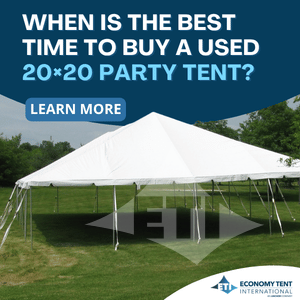
A 20×20 tent covers 400 square feet. It is a common party tent size for backyard parties, graduations, church events, vendor setups, and trade shows because it shelters a mid-sized crowd without needing a large site.
How many guests fit
Layout | Space per guest | 20×20 capacity |
|---|---|---|
Seated dinner (round or banquet tables) | 12 to 20 sq ft | About 20 to 33 guests |
Theater or ceremony rows | 7 to 10 sq ft | About 40 to 57 guests |
Standing, cocktail style | 8 to 15 sq ft | About 26 to 50 guests |
Use the low end if you need room for a buffet, bar, DJ, or dance floor, and confirm the limit with your local fire code. Our guide to planning seating in a commercial party tent walks through layouts in more detail.
Frame, pole, or canopy tent
Most used 20×20 party tents fall into three types. Knowing which one you are looking at tells you where you can set it up and what parts to check.
Frame tents are free-standing, with no center poles, so they work on grass, concrete, and asphalt. They still need ground stakes or additional weight on each leg. Commercial-grade frames use aluminum or heavy-duty steel tubing.
Pole tents rely on center poles and tensioned ground stakes, so they need grass or soil, plus room around the perimeter for stakes and ropes.
Pop-up canopy tents in a 20×20 size are mostly consumer products, often with a steel frame and a polyethylene tent top. They cost less, but many are designed for occasional use rather than weekly commercial rentals.
If you are looking for a used 20×20-foot event tent, here are a few points to consider:
Condition of the tent
 Ensure that the tent is in good condition and is not at risk of deteriorating as soon as it is set up. Check the fabric and seams for tears or holes, and examine the frame to ensure that there are no signs of excessive wear.
Price
The price. It is possible to find used tents at a fraction of the cost of new ones. Take the time to compare offers before finalizing your purchase.
Seller
The seller. When buying a used item, it is essential to deal with a reliable seller. Check online reviews or ask people you know for recommendations.
Return policy
The return policy. If the tent does not match its description or arrives damaged, you should be able to return it and receive a full refund. Confirm that the seller offers a satisfactory return policy before making your purchase.
Talk to a sales representative about your venue
Tell us the surface, the guest count, and the season. We will tell you whether a frame tent or a pole tent is the right call for your next outdoor event.
When it comes to party tents, timing is everything. If you’re looking to buy a used 20×20 party tent, the best time is in the spring or early summer.
That way, you’ll have plenty of time to set it up and use it before the colder weather sets in. There are a few things to remember when purchasing a used party tent for your outdoor events.
See also Why Your Event Company Needs to Offer Commercial Tents for Hire
Are you in the market for a tent?
 Economy Tent International has a wide selection of used tents, like canopy tents that are perfect for any occasion. We have the perfect tent if you’re looking to host an outdoor wedding tent or need a shelter for your next big event.
You can choose from:
Our tents are always heavy-duty in any condition, and our team is available for customer assistance for all your queries. Call us at 800-438-3226 for more details.
Here are a few tips to help you get the best value for your money:
Research
Do some research. Check out prices for new tents of the same size and style you’re considering, so you’ll have a good idea of the going rate.
See also How to Plan the Ultimate Outdoor Anniversary Party
Inspect the tent
Inspect the tent carefully. Ensure there are no rips or holes in the fabric and that all the poles and guy lines are in good condition.
Tent’s history
Ask about the tent’s history. Please find out how often it was used and how well it was cared for.
Bargaining
Bargaining is acceptable when buying a used party tent. Don’t be afraid to haggle a bit to get the best price.
Check a good deal
Be prepared to walk away if you don’t feel like you’re getting a good deal. There are plenty of used party tents, so you’re bound to find one that’s just right for you.
Do this in daylight, with the tent fully assembled if the seller will allow it. A cover that looks acceptable folded on a pallet will show every one of its problems once it is tensioned correctly. If the seller refuses to set it up, treat that as an answer.
Tent fabric perimeter. Walk the full edge and look for elongated grommet holes, torn keder, or stretched webbing. Damage at the tent fabric perimeter causing the cover to pull unevenly will spread across the whole top within a season.
 Seams and welds. Run a hand along every seal. Separation at a heat weld cannot be patched permanently in the field.
Wind crack damage. Hold panels against the light. Fine parallel cracking in the vinyl is cover wind whip, caused by a top that was left loose. It always gets worse.
Vinyl body. Commercial covers are heavy duty polyvinyl chloride. If the material feels brittle, chalky, or thin at the folds, the plasticizers have migrated out and the cover is near the end of its life.
Flame certification. Find the sewn in certificate tag. A fire resistant vinyl meeting NFPA 701 and California Fire Marshal Title 19 will carry proof, and many venues will not issue a permit without it. If the tag is no longer present, assume you cannot get a permit.
UV and mildew treatment. Original covers are UV resistant and mildew resistant. Grey blotching along fold lines means it was packed wet, and that staining is usually permanent.
Frame straightness. Sight down each leg and rafter. A bent steel frame member or a crushed tube end signals a previous partial or complete collapse.
Fittings and fasteners. Check every welded joint for cracks and every bolt hole for elongation. Fittings carry the load path.
Tension hardware. Ratchets should turn freely and hold. Worn hardware makes it impossible to maintain proper tension.
Anchoring kit. Confirm ground stakes, straps, and any ballast are included and sized for the tent. This is the single most commonly missing item in used sales.
Sidewalls and windows. Ask specifically whether sidewalls are included, and which window styles came with the set. Sidewalls included in the photograph are not always sidewalls included in the sale. Sellers often list a top only and let buyers assume otherwise.
Service history. Ask for the annual rentals, damage log, and whether routine maintenance checks were recorded. A fleet owner with real records is a good sign.
Do your own review of the paperwork as seriously as the fabric. Manufacturer name, model, year, original installation instruction guidelines, and any repair invoices tell you more about what you are buying than the seller’s description does.
If you are looking for an easy way to set up a used 20×20 party tent, follow these simple steps:
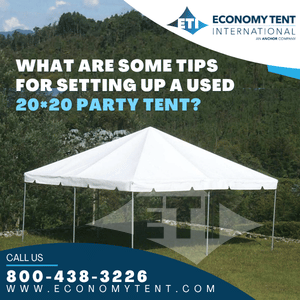 Locate the four corners of the tent and stake them into the ground properly for the tent to work correctly during the event.
Use the included ropes to secure the tent to the stakes.
If there is a rain fly, attach it to the poles at the top of the tent.
If there are any side panels, attach them to the poles on the sides of the tent.
Make sure that all of the zippers are closed and the doors are secured.
If there are any lights, string them up inside the tent.
Enjoy your party!
Buying used 20×20 party tents provide many benefits for your next outdoor event. Take note of all of these to purchase the best one! Contact ETI at 800-438-3226 for better assistance and a large selection of tents.
When you buy new, the manufacturer’s engineering, certification, and installation instruction guidelines come with the product. When you buy used, some of that history is missing, and the responsibility shifts to you.
Occupied tent emergencies
If wind or storm conditions exceed the tent’s rating, or if there is any risk of a lightning strike, a tent must be evacuated immediately. Guests should immediately evacuate to a permanent building, never to a vehicle parked beside the tent. Make this call early rather than watching the weather to see what it does.
Tension is not optional
 Most failures trace back to a cover that was never tensioned correctly. A loose top flexes with every gust, and that wind whip works through the vinyl until it splits. Proper tension protects the fabric and keeps the load moving into the frame the way it was designed to.
Water and snow are weight
Rain water pooling in a slack top adds enormous additional weight in a very short time, and snow loading does the same thing more slowly. Both have caused complete collapse in tents that were structurally sound but poorly pitched. Check your top during and after every storm and push out any pooling before it grows.
Anchoring for your site
Ground stakes work in compacted soil and do nothing in sand or over asphalt. Match your anchoring to the surface and to local weather conditions, and add ballast where staking is not possible. A standing tent is only as good as what holds it down.
Follow the manufacturer’s installation instruction guidelines every time. Cover improper installation with a written setup routine your crew signs off on, because improper installation is a far more common cause of failure than material defects are.
A used tent costs less up front, but the product cost is only part of the math. Compare what you get in each case before you decide.
Factor | Used 20×20 tent | New ETI 20×20 Trio tent |
|---|---|---|
Up-front price | Lower, varies widely by brand and condition | Published on the Trio price sheet |
Warranty | Usually none. ETI’s warranty applies to the original purchaser only and does not transfer. | One year against defects in material and workmanship |
Fire certification | Must be verified on the label | Cover meets NFPA 701 and California Fire Marshal Title 19 |
Expected lifespan left | Unknown | Full service life |
Frame | Condition and completeness vary | 6005 T-6 anodized marine aluminum, engineered and wind load tested |
Style and color | Whatever the seller has | Traditional, High-Peak, or Tension covers in solid colors or stripes |
Delivery | You arrange pickup or freight | Ships from Miami, Florida, usually within days |
Find your total equipment cost
Add the used asking price, the cost of any replacement parts or cover, delivery costs, and storage cost. Then compare that total with the price of a new tent. Some commercial replacement tops for 20×20 frame tents list for more than $1,000 on their own, so a used tent with a worn cover can cost close to new once you fix it.
Total equipment cost = purchase price + replacement parts + delivery costs + storage cost
A used tent makes the most sense when the cover is certified and clean, the frame is complete, and the price leaves room for a few replacement parts. If any of those fail, a new tent is usually the better long-term investment.
Want new without paying it all at once? ETI offers financing on commercial tents so you can spread the cost over time.